A piezoelectric crystal is a ceramic functional material with reversible electrical-mechanical energy conversion: squeezed, it generates charge proportional to the force (sensor use); subjected to an electric field, its dimensions change minutely (inverse piezoelectric effect). Because its internal resistance is extremely high and it consumes almost no energy, it is ideal for small, low-power pneumatic components — which is exactly why the piezo valve has become the core pneumatic element of smart valve positioners. Using HOERBIGER-ORIGA's P9 pilot piezo valve and P20 switching valve, this article explains the working principle, the three-state gas circuit, PWM control and the five key advantages.
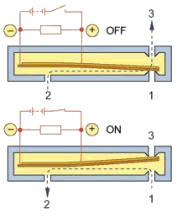
Figure 1. P9 working principle (original figure)
The P9 works through a piezo wafer: an extremely thin elastic metal plate with piezo crystals bonded on both faces, vacuum-coated with electrodes on the two working surfaces. De-energized, the supply port 1 is closed, output port 2 communicates with vent port 3, and output pressure is zero. Energized, the upper crystal contracts and the lower one expands, producing a lever effect that amplifies the mechanical deflection to tens of microns — vent 3 closes, air flows from port 1 to 2, and an output pressure signal is generated. Since wafer bending follows the applied voltage, the P9 works as a switching or proportional valve; see the pressure-voltage curve in Figure 2. Pilot valve response time is under 2ms.
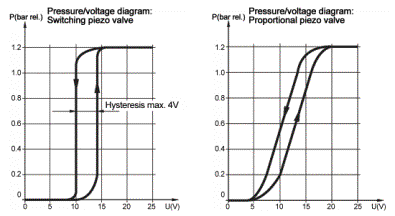
Figure 2. P9 pressure-voltage curve (original figure)
The P20 combines the P9 piezo wafer, a switching power amplifier, a micro pressure reducer and a 30μm filter into a 3/2-way valve. Official specifications:
| Parameter | Value |
|---|---|
| Operating voltage | 24VDC |
| Operating current | <10μA |
| Maintenance (holding) current | 0μA |
| Response time | <20ms (to 10% or 90% pressure) |
| Capacitance | <100nF |
| Operating pressure | 1.2-8.0bar |
| Flow | 130L/min (6→5bar) |
| Operating temperature | -30 to +60°C |
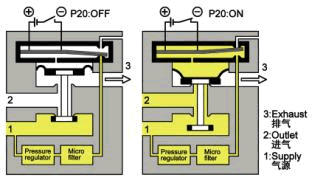
Figure 3. P20 working principle (original figure)
The piezo smart positioner's gas circuit uses two P20 valves (PV1, PV2) and two check valves (RV1, RV2) — remarkably simple (Figure 4). It has three logic states:
| PV1 | PV2 | RV1 | RV2 | Valve |
|---|---|---|---|---|
| ON | ON | open | closed | Admitting air |
| OFF | ON | closed | closed | Holding |
| OFF | OFF | closed | open | Venting |
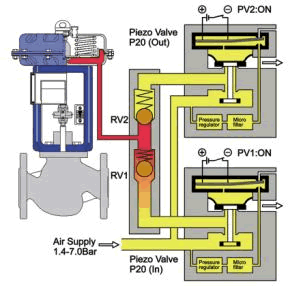
Figure 4. Gas circuit diagram (original figure)
When minor actuator leakage or a sudden line-pressure change disturbs the valve position, the positioner immediately switches from "hold" to "pulse" mode — with the P20's 20ms response, admit/vent flow is throttled to nearly zero, keeping position disturbance within 1%.
The piezo smart positioner drives the piezo valves with pulse-width modulation (PWM): large deviation → continuous signal; moderate deviation → pulses; small deviation → sparser pulses; once within the control accuracy band → no output, position held.
With piezo elements at its core, the positioner has few moving parts, small size and ultra-low power, with output flow continuously variable from 0 to 130L/min. Hence:
Need smart positioners or intelligent electric/pneumatic actuators sized and supplied? Submit an RFQ.

An industry resource for electric & pneumatic actuators, dampers and heaters: brand manuals, sizing guides and maintenance know-how. Global brands in, China manufacturing out.