I. Intelligent actuators — overview
With industrial development more users apply intelligent actuators, yet there is no unified definition. From the analysis of most manufacturers' products, an actuator qualifies as "intelligent" if: the main controller is a microcomputer chip; commissioning is non-intrusive (set entirely through external devices — keyboard, knobs, remote, laptop — without opening the housing or using mechanical tools); and it offers genuine smart functions (varying by make and control principle).
1.2 Features of Bernard intelligent actuators
Bernard of France is one of the world's most famous valve-actuator manufacturers — founded 1936, HQ in Paris, over 35,000 actuators/year for power, steel, refining, natural gas, water treatment, gas, heating, shipbuilding, automotive, aluminium and chemicals. On its classic mechanics Bernard built intelligent actuators with a distinctive style:
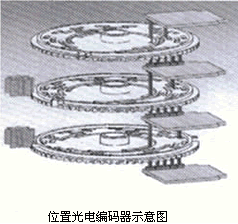
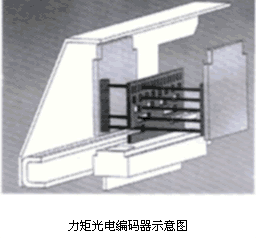
- Mechanical torque measurement: planetary-gear load measurement as in most traditional actuators — accurate and reliable — enhanced by an optical absolute encoder with lever amplification feeding exact torque values to the CPU.
- Optical absolute encoder: Bernard's own position/torque sensor — simple, stable, high resolution; no battery needed to keep origin or data: higher reliability, lower failure rate, lower cost.
- Advanced handwheel auto-clutch: a one-way drive design auto-switches between handwheel and motor drive — efficient and convenient; with the motor stopped, the handwheel operates the valve directly (electric priority).
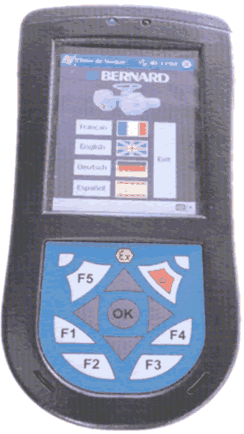
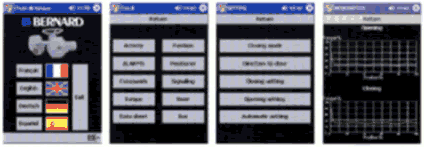
- Setting via PDA or laptop: the supplied panel sets parameters via simple menus; an optional handheld PDA talks by infrared, and an IR kit lets users set actuators from a laptop — also charting torque curves for valve-condition analysis and troubleshooting.
II. Main performance of the control system
2.1 Optical absolute encoder
High precision and reliability: mechanical measurement combined with computer processing; stable data, high accuracy, non-contact, long life. No battery needed to keep origin or data — reliability up, cost down.
- Position encoder: three discs on the main output shaft, up to 914 turns, 15-bit.
- Torque encoder: code plate connected to the measuring spring; dynamic measurement, factory-set maximum torque limit; 5-bit.
2.2 Central microprocessor
- Programmable microprocessor: convenient, accurate operation and control; position, torque and fault status always monitored; during maintenance, changed parameters help locate faults.
- Large storage: roomy EEPROM holds all settings/data acquisition and the last full-stroke torque curve for reference — no backup battery needed.
2.3 Control system I/O
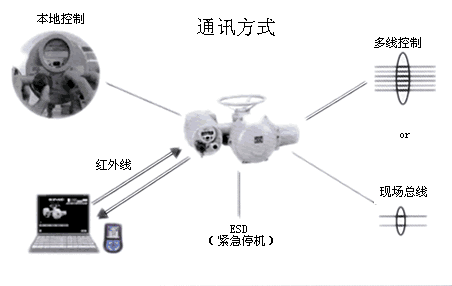
- Multiple communication: remote control compatible with ordinary actuators — multi-wire, fieldbus (module), 4–20 mA (module) to the control room; local panel operation, or direct control via PDA/laptop (IR kit).
- Status outputs: 4 bistable relays programmable among 23 options; an extra relay group (3 monostable, optional) when the standard set is insufficient; power-down-release relays need no backup battery.
- Fault relay: energized type — releases on fault or power loss; 5 selectable standard fault states by programming.
- Multi-language display: precise display of position (0% closed / 100% open), torque (% of max), alarms and the setting/diagnostic menu — in the user's language.
- Local status: LCD shows opening, torque % and alarms; red LED flashing = closing, green = opening.
- Non-contact knobs: magnetic contact-free knobs for all local operations while keeping the protection rating.
- Local control: each knob position (remote/local/STOP) has a locking detent against misoperation; STOP inhibits everything.
- Setting & diagnostics without tools or opening the housing — even in hazardous areas.
- Auto setting: factory-set to order; normally only precise open/close positions need setting; for gate valves the actuator finds the positions automatically and optimizes by measured inertia.
- Infrared: standard IR interface for the PDA, or IR kit + INTELLISOFT software for laptops; after setting one actuator, download the data to any number of others.
- Delay (variable speed): to prevent water hammer, running and dwell times are programmable.
- Operation logging: total/section run time and starts (total, or last 12 h); handwheel operation is correctly reflected; torque is monitored and the last full-stroke curve recorded.
- Alarms: 19 alarm states queryable locally or via fieldbus; a blinking box on the LCD signals them; most alarms don't block operation (e.g. "too frequent starts") and clear automatically.
- Phase-sequence monitoring: correct rotation regardless of wiring; phase loss stops the actuator with an alarm.
- Fault tolerance: ESD control configurable — options let ESD override motor-thermal or torque alarms and force the valve.
- Data sheet: memory stores user code, manufacture date, serial number, motor duty, modulating class, etc.
- Password protection: menu changes can be password-protected.
- Reversal delay: a minimum delay (~200 ms) when reversing protects the mechanics.
- Fuse protection: three fuses on the main control board.
2.4 Options
- Handheld PDA controller: industrial PDA running Windows with dedicated software — IR to the actuator (40 cm), Bluetooth/IrDA to PC; download data in the office, then to the actuator on site; even remote data exchange with Bernard service; open/close/stop operation, parameter setting, torque curve display.
- INTELLIKIT (laptop IR kit): IR interface (RS232) plus a clamp-on IR head facing the actuator window, with INTELLISOFT software (CDROM, WIN98) — PDA-like functions.
- Position transmitter: isolated 4–20 mA / 0–10 V position signal, internally powered.
- Torque transmitter: continuous torque monitoring, isolated 4–20 mA output; supplied with the position module.
- Analog control module: enables 4–20 mA (or 0–10 V) command; software auto-configured, isolated, includes both functions above.
- Extra signal output: relay module with 3 monostable relays — with the original four, up to 23 actuator states selectable.
- Fieldbus: DUPLINE DS200, PROFIBUS, MODBUS, FOUNDATION FIELDBUS via different interfaces; all commands and data over the bus.
2.5 Non-intrusive commissioning
Actuators are factory-set to order — normally no parameter change is needed. After mounting on the valve, open/close positions often need re-setting: manually via the panel menu, or automatically — the actuator detects the positions by torque over one round trip and optimizes the result by measured inertia. Parameters (closing direction, torque/limit closing, open-close priority, torque limits, etc.) can be modified the same way, also via PDA/laptop.
2.6 Fault diagnosis and maintenance
- Function monitoring: internal elements (torque/position sensors, CPU, EEPROM) are monitored with alarms; running anomalies (over-travel, stall, wrong direction, phase loss, over-heat) also alarm.
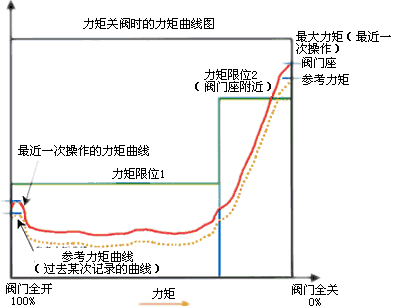
- Torque monitoring: real-time torque on the valve with two limits per stroke — e.g. gate valves use a higher seating torque ("torque 1") near closure and a lower running torque ("torque 2"); for inertia-critical cases the limit can be masked at opening.
- Torque curve recording: the last stroke is recorded and a user reference curve stored; curves upload via IR to PDA/laptop or by fieldbus to the control room or office PC.
Related reading: ST control systems & usage | Bernard atlas | Bernard column