Cold/hot air isolation dampers are the on-off type dampers of the boiler air & flue-gas system: installed in cold-air ducts and hot primary/secondary air ducts, they isolate entire duct sections when mills, air preheaters or other equipment are under maintenance or during fault conditions — they only "fully open / fully close" and do not modulate flow. Two key terms first: by duct cross-section there are rectangular dampers for square ducts and circular dampers for round ducts, with single-blade or double-blade plates (a double-blade pair forms a seal-air chamber in between); they are driven mainly by quarter-turn electric actuators or cylinder-type pneumatic actuators with handwheels, ensuring manual operation on power or air failure. Hot-air media temperature can reach 300-400 °C depending on the air-preheater outlet. Product photos: Shandong Yingkong Intelligent Technology (cgyingkong.com).
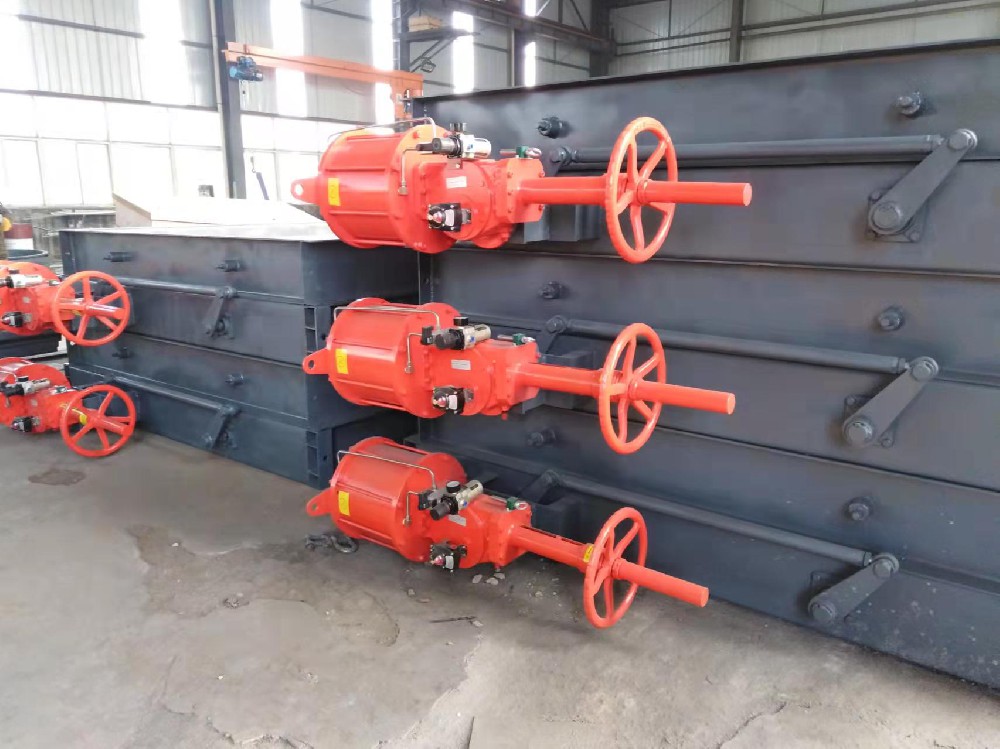
Rectangular isolation dampers with cylinder-type actuators and manual handwheels, in the workshop (photo: Shandong Yingkong)
Typical locations in the boiler air & flue-gas system: the hot primary air duct at mill inlets (isolating hot air during mill maintenance), air-preheater inlet/outlet ducts (isolating the preheater), secondary air mains and branches, and cold-air ducts of the pulverizing system. Unlike regulating dampers (any opening for flow control) and fast-closing dampers (trip service), the isolation damper's mission is to seal tight and isolate reliably, so maintenance personnel can work safely downstream and standby equipment can be split off from the running system.
| Dimension | Type | Description |
|---|---|---|
| Duct section | Rectangular | For large rectangular ducts; frame + single/double blade |
| Circular | For round ducts; flanged frame + rotating blade | |
| Blade | Single blade | Simple; blade edge presses sealing strips against the frame |
| Double blade | Cavity between two blades can receive seal air for a higher isolation class | |
| Motion | Rotating | Blade rotates about 90° to open/close (mainstream) |
| Sliding gate | Gate slides in/out of the frame; requires side space | |
| Drive | Electric actuator | Quarter-turn; handwheel operation on power failure |
| Cylinder pneumatic | Fast two-position stroke; handwheel fitted for manual action on air failure | |
| Manual | Small sizes or infrequent operation |
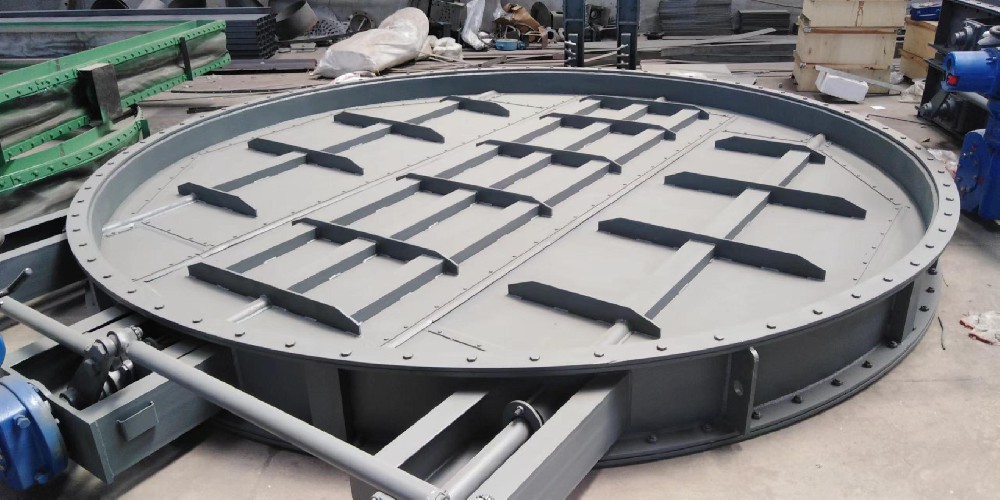
Large circular isolation damper: double blades with stiffeners, electric actuator via linkage (photo: Shandong Yingkong)
Cold-air media runs near ambient; hot-air sections (primary/secondary air after the preheater) reach 300-400 °C. Materials are graded by temperature: plain carbon steel frames (commonly Q235B/Q345) for lower temperatures, heat-resistant grades for hot sections with attention to thermal-expansion allowance — frames and blades of large dampers must accommodate thermal growth, and sealing strips use heat-resistant stainless steel. Duct design pressure is low (usually within ±10 kPa); blade strength is checked against the differential-pressure case.
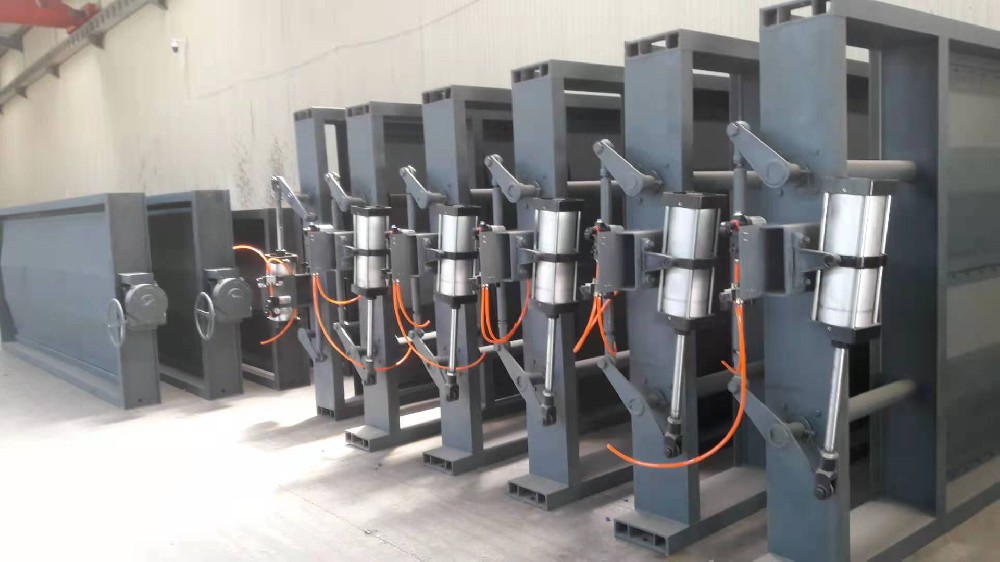
Damper array: each damper has its own cylinder actuator and manual handwheel (photo: Shandong Yingkong)
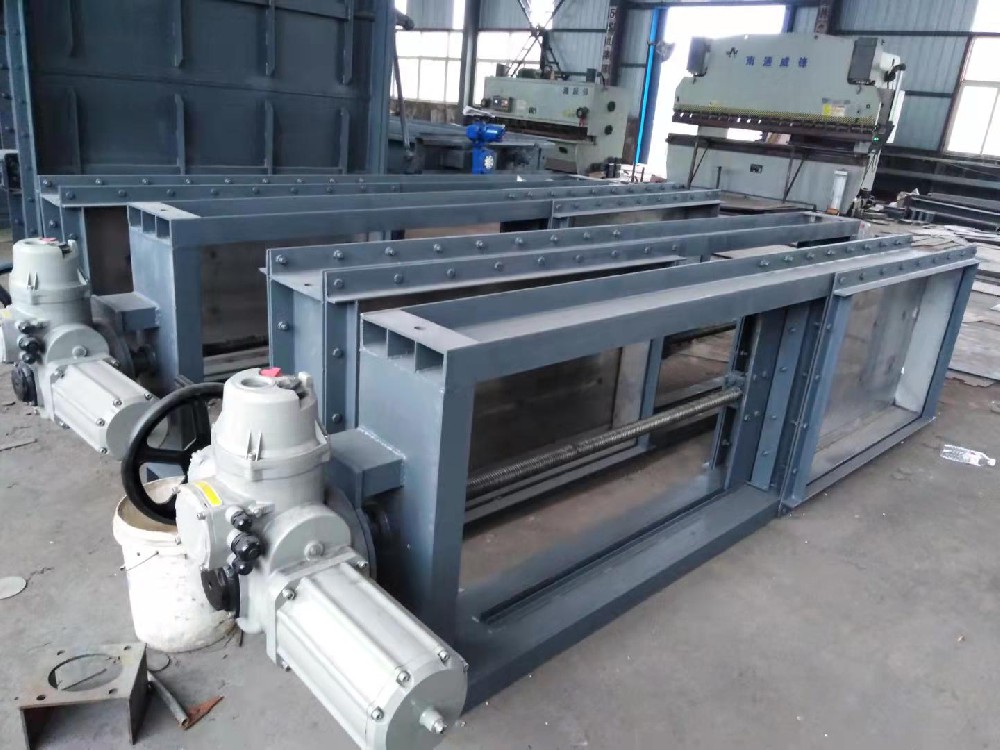
Sliding-gate isolation dampers with multi-turn electric actuators and drive screws (photo: Shandong Yingkong)
| # | Please provide when ordering |
|---|---|
| 1 | Duct section: rectangular A×B or circular DN (mm), orientation |
| 2 | Media: cold/hot air; design and operating temperature (°C) |
| 3 | Design pressure and operating differential (kPa) |
| 4 | Isolation class: standard, or seal-air near-zero leakage |
| 5 | Blade type: single/double blade; rotating / sliding gate |
| 6 | Drive: electric / cylinder / manual; required state on power or air failure |
| 7 | Stroking time (s) and operating frequency |
| 8 | Control: position feedback, interlock signals, bus/analog |
| 9 | Flange interface and sealing-strip material requirements |
| 10 | Coating and anti-corrosion requirements (indoor/outdoor) |
Need cold/hot air isolation dampers, dampers, or matched electric/pneumatic actuators sized and supplied? Submit an RFQ.

An industry resource for electric & pneumatic actuators, dampers and heaters: brand manuals, sizing guides and maintenance know-how. Global brands in, China manufacturing out.