With tightening energy and environmental policies, nuclear power is a key direction for future generating capacity — and nuclear safety places exceptional demands on control-valve electric actuators.
1. Performance
The valve electric actuator (Fig. 1) is a vital drive device in nuclear plant process control, providing travel control, torque protection, manual/electric changeover, and remote/local operation. It converts electrical command signals from the supervising equipment (controllers, PLC, DCS) into displacement, driving valves or dampers to the demanded position to regulate flow, air, temperature and pressure. Actuators usually work in analogue or pulse mode with point-to-point connection to the system.
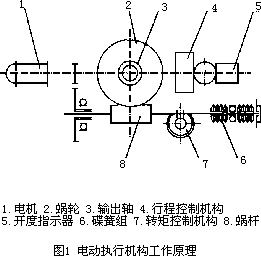
Fig.1 Valve electric actuator
2. Special requirements
1. Service life: heavy-water reactor plants are designed for 40 years; actuators must be designed for 40 years, or at least fault-free over one refuelling cycle.
2. Safety classes: actuators are graded K1/K2/K3. K1 units sit inside the containment and must perform their function in normal conditions, under SL2 (safe-shutdown earthquake) loading, and during/after accidents (60–156 °C, 0.6 MGy gamma dose); K2 units sit inside the containment for normal conditions plus SL2; K3 units outside the containment. Normal-condition parameters (temperature 5–55 °C, 100% RH, seawater spray, vibration 10–2000 Hz at 2.5 m/s², 250 kGy gamma) are graded by nuclear safety regulations.
3. Seismic class: actuators in critical locations must work during and after earthquakes.
4. Radiation resistance: actuators inside the nuclear island must not fail from irradiation-induced material degradation.
5. Others: thermal stability, moisture resistance, chemical stability and fire performance are also required.
3. Design
1. Protection: containment actuators risk radioactive dust contamination and must be washable with clean water, without leaking oil or fluids to the environment. Enclosure and explosion protection follow GB 4208 and GB 3836 — IP67 is appropriate (lower fails the duty; higher wastes cost). Coatings follow EJ/T 1022.17. Grounding bolts are mandatory: ≥M8 for motors ≤5 kW, ≥M10 for 5–10 kW, ≥M12 above; clearances and creepage per JB 911.
2. Materials: enclosures must be spheroidal-graphite cast iron; aluminium, zinc and their alloys are prohibited except for non-critical external parts; lubricants must be special high-temperature radiation-resistant grease; fasteners, screws, nameplates and rivets must be stainless steel.
3. Components: ① cables must meet nuclear standards and withstand radiation — 10 rad/h continuously (~0.4×10⁷ rad over 40 years), up to 5×10⁷ rad in accidents, with unchanged electrical properties; 300 V control cable for <200 V DC systems, 600 V for 200–400 V DC; ② connectors must be explosion-proof with dedicated cable-gland fixing and sealing; ③ common seals (O-rings, square rings, lip seals) have low radiation resistance — special materials such as FKM are required.
4. Structure: nuclear plants are compact — ① mechanically, variable-frequency motors match duty speeds while minimising the gear train; ② fieldbus technology enables automation plus remote control, diagnostics, maintenance and operation; ③ interfaces must be modular and quickly interchangeable, following DIN 3338, DIN 3210, GB 12222 and JB 2920 to minimise special designs; ④ sealing must work both ways — "nothing in from outside, nothing out from inside" — using high-performance radiation-resistant O-rings, square rings and lip seals with appropriately raised surface-finish requirements on rotating faces.
4. Special testing
1. Thermal ageing: 950 h at 135 °C in dry air (test time τ 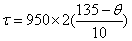 scaled for other temperatures, minimum 100 h); during the test the actuator must complete at least 10% (200 cycles) of the specified mechanical-wear cycles under load.
2. Irradiation ageing: before irradiation the actuator completes 50% of the mechanical-wear cycles; irradiation runs in dry air at 70±3 °C to a 250 kGy gamma dose with no significant performance change; afterwards it completes the remaining cycles.
3. Accident simulation: irradiation-condition testing (70±3 °C, 600 kGy gamma at 0.25±0.14 Gy/s) plus hot/moist tests — LOCA and MSLB scenarios per EJ/T 1022.11-96 PWR containment parameters, with the actuator installed in a test cell with cable glands, sealing faces and dedicated piping, operated at rated load while mechanical and electrical data are recorded.
5. Conclusion
Nuclear-grade actuators demand — and receive — exceptional production discipline: manufacture is only permitted under a nuclear quality-assurance programme (HAF040), and transport, storage and custody must equally follow the rules for the equipment to deliver its value.
We supply actuators for power and nuclear-duty applications together with spare parts — contact us for selection advice.
Source: compiled from public technical literature by this site.