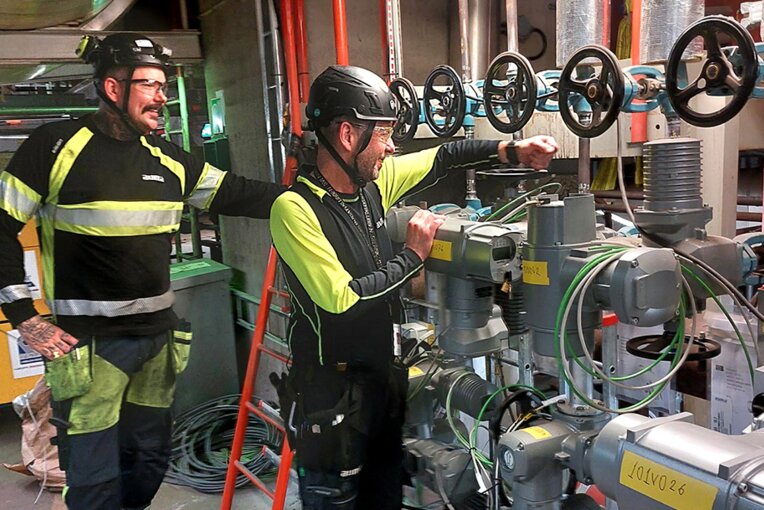
Image: Electric actuators in a CHP plant (source: AUMA)
Electric actuators are indispensable in automatic control systems. By operating mode they fall into three classes — multi-turn, linear and quarter-turn. As one of the terminal elements of plant control, they convert the controller's signal proportionally into linear or rotary motion to drive control valves, dampers and other final elements. Their performance directly affects the reliability, safety and economics of the entire plant.
For two-shift peaking plants, daily start-stops are hard on actuators, causing internal leakage of motor-operated valves, jamming, and failure to respond in both remote and local modes. Peaking units therefore place higher demands on actuator selection, application and maintenance.
1. Selection Analysis
Selection often focuses on valve parameters while actuator requirements are overlooked, preventing best performance and causing commissioning trouble. Key points:
1. Match the actuator to the valve type — valves vary in principle (rotating disc, rising stem); start from the valve type;
2. Determine the control mode — on-off (open loop) or modulating (closed loop);
3. Define the electrical parameters — motor power, rated current, secondary control-circuit voltage differ between manufacturers; mismatches cause breaker trips, blown fuses and thermal-overload trips;
4. Determine output torque — valve torque demand depends on size and pressure, and varies even between nominally identical valves from the same maker due to machining and assembly differences; undersized torque means the valve cannot be operated — keep a reasonable margin;
5. Specify enclosure and explosion-proof ratings for the installation.
2. Faults by Service Phase
1. Commissioning (run-in) phase: causes are complex — selection, design, manufacture, installation and management issues intertwine. Typical faults: heavy leakage, unstable speed adjustment, jammed or sluggish mechanisms from dirt and oil, missing or wrongly fitted springs and seals, unsteady motion, poor positioning accuracy. Examples: undersized torque affecting stroking speed; loose linkage between actuator and valve; power and signal cables in one conduit causing interference; nearby unshielded large motors; oversized positioner fuses destroying internal chokes. Handle patiently, one by one, and catch them early.
2. Early and mid-term operation: a few seals fail early from assembly or material quality; burrs, casting sand and debris break loose and destabilize components; occasional electronic components prove defective. Strengthen inspections, report to the manufacturer, keep statistics and stock spares.
3. Late-term operation: wear parts exceed limits one after another — motor winding aging lowers insulation and stability; poor lubrication degrades smooth running; positioner coils and position transmitters age, reducing positioning accuracy; gearbox wear prevents modulation. Inspect regularly, replace failed parts promptly; note also human factors — foot traffic, jammed dampers, misoperation.
3. Maintenance
An electric actuator consists mainly of the motor, bearings, gear train and electronics. US military standard MIL-HDBK-338 reliability data show failures concentrate in the motor and bearings: among motor faults, winding failure 20%, bearing failure 45%, slip-ring/brush/commutator damage 5%; among bearing faults, lubricant degradation/loss 45%, contamination 30%, spalling 5%, misadjustment 5%, corrosion 5%. Good maintenance management markedly improves reliability:
1. Manage lubricant cleanliness — too low a viscosity accelerates gear wear and loses accuracy; too high causes sluggish action; wear debris, moisture ingress, coating flaking and rust all degrade the oil;
2. Improve the working environment and conditions — reliability and life relate directly to usage, environment and staff competence;
3. Fix grease leaks promptly — high-frequency, fast duty inevitably brings shock loads; address leaks as soon as they appear;
4. intensify maintenance during the early-failure period — early faults stem from initial design/manufacture/installation errors and are proportionally high;
5. Raise maintenance staff competence — design with foresight: simplified systems, high standardization and interchangeability, integration, and new technologies such as fault diagnosis, localization and fault tolerance;
6. Periodic inspections against random failures — keep phase-wise maintenance records and historical archives for accurate diagnosis;
7. Manage equipment ledgers — record every fault in detail: symptom, analysis and search process, cause, remedy and preventive measures.
4. Conclusion
Systematic management of actuators across selection, commissioning and operation reduces failure rates sharply compared with the early period and raises reliability markedly. Correct use and maintenance improve control reliability, extend service life, and bring considerable energy-saving economic benefits.
We supply electric actuators of all major brands with spare parts and power-industry selection, commissioning and maintenance support — contact us.