What is the biggest maintenance difference between bus-type (Profibus DPV1 / FOUNDATION Fieldbus H1) positioners and ordinary HART positioners? In one sentence: never power-cycle them casually — a sudden power loss can corrupt the Device Description (DD) file inside the positioner and leave the device impossible to configure or calibrate. This article republishes, with edits, a DeltaV bus-positioner fault case from the Chinese valve portal ocpv.net (a DVC5000F on loop FIC1133): the full fault sequence, bus-device state-transition rules, and the complete commissioning procedure for bus positioners — a reference for instrument teams running DeltaV/FF bus actuators.
The unit used a DeltaV system; most loops were conventional instruments, with some transmitters and positioners on the fieldbus. Spur-side bus devices enter a field junction box; the trunk lands on an MTL5995 in the control-room cabinet and then on a DeltaV H1 card, with 24 V supplied by the MTL5995.
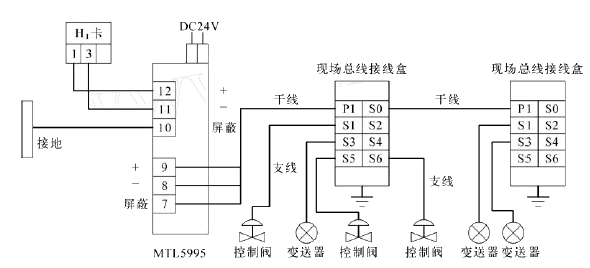
图1:总线仪表接入系统的方式(图源:调节阀网原文)
During a turnaround, bus device FIC1133 (a DVC5000F bus positioner) suddenly could not be calibrated — it had calibrated fine before. The likely cause: construction staff powered the positioner down without first running Decommision, corrupting its configuration. The operator-station faceplate showed IMAN (initializing-manual); Explorer calibration always failed to go Out Of Service; Transducer 450 showed the device as Bad. After Decommision, power-cycle and re-Commision, it then reported Can’t update.
Root cause: the sudden power loss corrupted the Device Description (DD) file in the positioner, making normal configuration and calibration impossible. In FOUNDATION Fieldbus, the DD is like a device driver — it contains the calibration routines, parameter routines and everything the control system needs to talk to the device; standard DDs come from the Fieldbus Foundation, vendors may ship enhanced optional DDs.
(1) The Travel Control range was found set to 49.5–50% (normal 0.5–99.5%); after correction the valve hovered at 50% for demands below 50% and did not move above it. (2) Travel Calibration: take the device out of service, shut off air so the valve rests at the de-energized position, pin the feedback lever at zero with the positioner’s pin, and adjust the lever-root position. (3) The faceplate then changed from IMAN to MAN; a 50% demand drove the valve to 50%, but demands below 50% drove the field valve fully closed and above 50% fully open. (4) Decommision + power cycle still abnormal. (5) Finally, connecting via H1 with the AMS Valvelink tool: in OOS, ResetResource and Travel Sensor Motion, Calibration kept reporting a DD file error — re-transmitting the DD file to the positioner with Valvelink and choosing Default 50% at the zero/spot step restored the device.
Bus devices are intelligent instruments — never power them down casually for maintenance. The source article summarizes bus-device maintenance as a state-transition diagram:
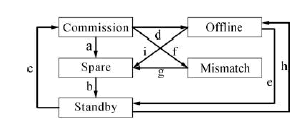
图2:总线设备的状态转换(图源:调节阀网原文)
| State | Rules |
|---|---|
| Spare | A commissioned device removed from the segment after decommissioning loses its address and tag (a); decommissioned but still on the segment goes to Standby (b); a mismatched device used as spare (g) |
| Standby | A spare dragged to a matching, commissioned placeholder (c); a spare taken offline (h — allowed but rarely useful); connecting to a segment that already has the same tag: set Spare first and delete the tag without removing from the segment (i) |
| Offline | A commissioned device placed offline keeps its tag and address — for brief removal and return to the same spot (d); a previously offline device reconnected to a different segment (e); removed from a segment and reconnected to a new one — possibly the wrong one (f) |
| Step | Action |
|---|---|
| a) Bring online | After physical connection and power-up, the positioner model appears in the H1 card’s Decommission list; select, set to Spare, rename to the new tag (e.g. FV1133), download |
| b) Setup Wizard | Transducer 450 right-click Setup Wizard: choose data matching the actual valve (size class, standard sliding-stem, air-to-open/close); edit Input Characterization |
| c) Auto-calibrate | If it will not start, check the Travel Count is within 15,000±2,000 (no air); adjust Travel first if not |
| d) Optimize | After calibration a Stablize/Optimize is offered — optional |
| e) Verify | Use Stroke Valve to command positions and confirm via the returned feedback values |
When the positioner stays in IMAN and will not enter AUTO or CAS: (1) confirm the feedback lever is installed correctly and the Travel Count (no air) is within 15,000±2,000 — otherwise run Travel Calibration first; (2) follow the Decommision/Commision sequence above, re-transmitting the DD with Valvelink if needed; (3) then repeat steps b–e. The takeaway: for bus-device maintenance, think state transitions before touching power; always Decommision before a power cycle.
Fisher DVC2000 hands-on · Pneumatic positioner principles · Fourth-generation DCS · Valve-position trust: what if neither is telling the truth
For bus-type and smart actuators submit an RFQ.
Source: ocpv.net (China Valve Network), "DeltaV bus-positioner fault troubleshooting" (May 16, 2011); republished with edits and original figures.

An industry resource for electric & pneumatic actuators, dampers and heaters: brand manuals, sizing guides and maintenance know-how. Global brands in, China manufacturing out.