Why do many automation processes require variable-speed actuators? In an automatic loop the quality of the executing unit is critical. Every loop has different process time constants, lag and gain — so the electric actuator should offer matching working speeds. The system wants fast valve action (high servo-motor speed), good dynamic response and strong correction at large deviations; near setpoint at small deviations it wants slow movement (low speed) to avoid overshoot. Pneumatic control valves achieve this easily via derivative action or positioners, but once a motorised valve is selected its speed and travel time are fixed, unable to meet the demand — so fine control near setpoint comes from frequent starts and stops, causing loop oscillation and burnt motors. Variable-frequency motorised valves solve this easily.
At large deviations the derivative action raises the inverter output frequency, so the valve motor runs fast — up to 1.5–2× the present working speed — with excellent dynamic response. As deviation shrinks the inverter frequency falls markedly, slowing the motor to 0.2–0.5× present speed; the valve inches open or closed, greatly enhancing fine-control ability, eliminating frequent starting near setpoint, visibly reducing overshoot and raising loop quality. The variable-speed scheme uses the standard signal to control the inverter output: inverters all have a 4–20 mA frequency-set input — feed it the signal, vary it, and stepless variable-speed running follows. Such actuators and valves no longer show the on-off/integral characteristic but a dynamically variable-speed, variable-integral one, with open-loop behaviour better than pneumatic valves — a large quality gain.
For high-quality, high-precision control an electric actuator must first respond sensitively to small signal changes; for good dynamic response its speed must be proportional to signal amplitude; and to overcome steady-state error it must run slowly, with very fine corrective action. Plainly an actuator without variable speed cannot meet these demands.
The intelligent variable-frequency actuator applies digital inversion and single-chip technology to existing electric actuators, adding intelligence, variable-speed running, good dynamic response, high positioning accuracy, stability, low failure rate, long life and wider applicability. Paired with various valve bodies they form intelligent variable-frequency motorised valves. During modulation the plug speed varies: at large deviation between command and feedback it is faster than ordinary motorised valves, accelerating correction; as deviation shrinks the motor slows, plug speed falls, slowest near the balance point — the valve inches open or closed with extremely fine resolution, greatly improving control accuracy.
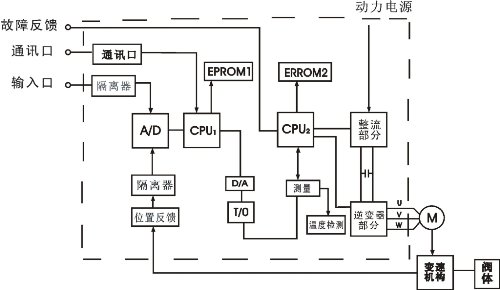
The figure shows the principle of the intelligent electronic variable-frequency motorised valve: electric actuator, valve body and control section, the latter split into main-circuit motor control and secondary parameter control. Integrated design unites modulation, computation, servo and inversion — simple and reliable.
Briefly: the 4–20 mA (1–5 V) input (or digital communication) and 1–5 V position feedback enter the intelligent controller's A/D; the CPU, per external parameter settings, compares and computes, outputting a switching signal matching the deviation direction and an analogue signal proportional to deviation size; these set the inverter frequency, regulating servo-motor speed and direction, continuously positioning the valve — automatic control. The inverter protects the motor against overload, short circuit and phase loss, raising corresponding alarms. The RS-485 port is the standard link to the outside under the communication protocol.
The valve meets various duties through parameter setting: parameters enter the program via the setter, the CPU runs the valve by the stored program; EEPROM stores settings; the watchdog ensures reliable program operation.
Open-loop characteristic: shown below; the input is a step.
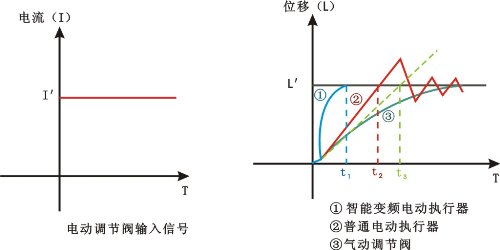
Open-loop characteristic of the intelligent variable-frequency valve
Curve 1 (the intelligent variable-frequency valve) begins slowly — soft start, reducing starting current — then approaches L' at high speed, its slope far exceeding curves 2 and 3. Approaching L' the slope falls and speed drops, slowest near L'; entering the insensitive band, electric braking stops the valve at L'. Compared with motorised and pneumatic control valves, the intelligent variable-frequency valve's open-loop characteristic is clearly superior.
Comparison with motorised/pneumatic valves