AUMA (Germany) is the world's second-largest actuator manufacturer. As automation grows across industries, electric actuators play an ever larger role in process control; AUMA's 30+ years of design, development and manufacturing underpin its reliable products.
AUMA NORM (basic unit) — construction
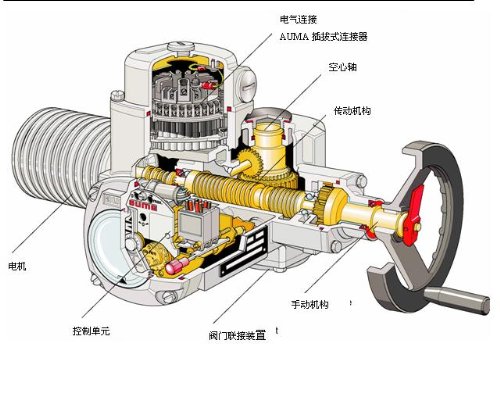
The whole multi-turn range shares one modular design. The standard AUMA NORM configuration comprises: motor, drive train, control unit, electrical connections, valve coupling and manual mechanism.
- Drive train: worm gearing reduces motor speed to the required output; self-locking when the motor is stopped; cast-iron gearbox.
- Valve coupling: various output drives to suit different valves; dimensions to ISO 5210 or DIN 3338 (DIN 3210 on request).
- Manual operation: travel switches and emergency operation can be set; with the motor stopped, the changeover lever disengages the motor and engages the handwheel. The design is electric-priority: starting the motor instantly re-engages the drive and the handwheel stays still. Emergency operation via a portable actuator requires a special coupling (max 300 rpm).
- Lockable handwheel mechanism (option): prevents unauthorized manual operation.
- Motor: specially developed AUMA motors with high starting torque — necessary for unseating fully closed valve discs and tight torque closing; torque changes during travel barely affect speed.
- Electrical connection: via AUMA plug-and-socket connectors.
AUMA NORM technical data
- Supply: 380 V ±20%, 50 Hz ±1%, 3-phase; normal starting even at the voltage minimum; travel change ≤1.5% of stroke
- Duty: 1200 starts/hour
- Motor: three-phase squirrel-cage, class F, thermal switches in each winding (140 °C); high starting torque, low inertia
- Dual limit and torque switches plus two freely settable intermediate signal contacts; each pair with independent NO+NC contacts, no common; 250 VAC 5 A, mechanical life >2 million operations
- Modulating types: 4–20 mA feedback, max load 600 Ω
- Self-locking worm gear against coasting
- Independent handwheel at any time, self-locking retained; auto-return to electric on power-up
- Travel times: see datasheet
- Working temperature -30 to +80 °C; 10 °C ambient change ≤1.5% of stroke
- Relative humidity ≤95%
- IP67 submersible (1 m water, 30 minutes)
- Torque/thrust adjustable ±20% of nominal, travel ±10%; travel time adjustable
- Finish: corrosion-resistant mica-infused coating, smooth faceplate and nameplate
- Self-adjusting compartment heater against condensation
AUMA MATIC (integral motor control unit)
An actuator with AUMA MATIC = basic unit AUMA NORM + the programmable integral control unit MATIC. Benefits: greatly reduced site wiring and cost; relays are not in a remote cabinet, so torque/travel switch action stops the motor immediately without long delay; flexible integration into process-control systems or standard fieldbuses (PROFIBUS-FMS/DP, INTERBUS-S, MODBUS-RTU).
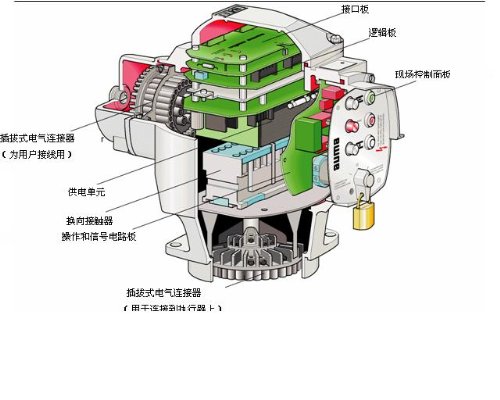
MATIC comprises: reversing contactor for motor power; operation & signal board (primary fuses, relays for field-button commands, optional indicators); interface board (opto-isolators, relays, LEDs); SMD logic board (CMOS FETs, programmable internal/external signal connections, DIP-switch motor control); plug-and-socket connectors joining NORM and MATIC; user wiring connector; local control panel with field/remote selector and buttons; power supply unit. The modular design makes reconfiguration easy; NORM and MATIC connectors are identical, making upgrades easy. Applicable models: multi-turn SA 07.1–SA 16.1 (on/off), SAM 07.1–SAM 16.1 (modulating); part-turn SG 05.1–SG 12.1. MATIC comes in Ex versions — standard units must not be converted to Ex (SA Ex/SAM Ex).
AUMA MATIC technical data
- Slot connection between MATIC and NORM, mounting direction selectable in 90° steps
- Local panel: Remote-Off-Local selection, open-close-stop buttons, fully open/closed position lamps and fault lamp
- Working temperature -30 to +80 °C; humidity ≤95%
- IP67 submersible (1 m water, 30 minutes)
- Input impedance 250 Ω; closing-type accepts pulses or dry contacts from the control room
- Modulating accuracy (dead band): 0.5–2.5% adjustable
- Control and feedback signals connect directly to the DCS without conversion or isolation equipment
- Maximum cabling to the control room: command, position feedback, power, contact and fault signals
- Integral power board: user provides mains power only
- Signal-loss protection: run-open / run-closed / stay-put, field-settable
- Fault protection & alarms: over/under-voltage, over-current, phase loss and auto phase correction; alarm contacts for phase reversal, phase loss, mid-travel torque and motor thermal trips
- Insulation resistance: terminals-housing 20 MΩ; power terminals-housing 50 MΩ; input-power terminals 50 MΩ