One plant operates 20 AUMA intelligent electric actuators imported from Germany. Compared with the former domestic actuators they offer higher control accuracy, stronger reliability and easier field commissioning. Reliability features: preset action direction on power/signal loss; thyristor contactors; non-contact position feedback; motor temperature protection. Open/close action by travel or torque is freely configurable to control control-valve leakage, and travel, torque, feedback and dead band are all set by potentiometer — field commissioning is simple. The AUMA is also dust- and water-resistant with well-sealed lubrication.
1.1.1 Mechanical limit adjustment
(1) Travel: open the side cover of the NORM unit; handwheel the valve fully closed and press adjuster A1 in the WDR direction until counting cam C reaches the closed mark D; same for full open with A2/C2/D2.
(2) Torque: loosen the two screws beside the closing travel column A1 and set the closing torque; similar for opening.
(3) Operate electrically locally to verify travel and torque action.
1.1.2 Position feedback adjustment
Close fully locally and adjust the zero potentiometer W until feedback is exactly 4 mA; open fully and adjust the span potentiometer until 20 mA; repeat zero and span.
1.1.3 Signal balance adjustment
Balance the command and feedback signals per the table:
| 输入信号 | 阀门位置 | 调节方法 |
| 4mA | 全关 | 顺时针调节 P3,使对应的关灯恰好亮 |
| 20mA | 全开 | 逆时针调节 P4,使对应的开灯恰好亮 |
(1) Avoid scrambling the travel: the counting gear train comprises the position potentiometer, driver and driven gears, variable gears, counting gear, travel cams, torque cams, counting cam and travel column. If the potentiometer bottoms out before the gear train reaches the end, the mismatch disables the travel switches and causes gear slippage. If the travel is scrambled, loosen the potentiometer nut, lift the driven gear to disengage, and wind the potentiometer back.
(2) AUMA modulating actuators have a 250 Ω load capability, while ordinary operationers parallel 250 Ω resistors for 1–5 V output — this can cause "works locally, not remotely". Remedy: short the operationer's 250 Ω resistor or insert a signal isolator, which also improves AUMA interference immunity.
(3) Counting-gear ratios differ between travel ranges — do not substitute between actuator sizes.
Tree 1 resolves local open/close failures. Its "step 3" covers mechanical faults (gear wear from lost lubrication, bearing wear from misalignment, slipping manual/auto changeover), and "step 10" motor thermal-trip — mainly caused by actuator-to-stem misalignment. Align by measuring the output shaft to the four supports at closed/mid/open positions and shimming the mounting flange until the axes coincide:
| 位置 | 支架1 mm | 支架2 mm | 支架3 mm | 支架4 mm |
| 全关 | 60.5 | 60.5 | 59.5 | 59.5 |
| 中间 | 60.2 | 60.2 | 59.9 | 59.9 |
| 全开 | 60 | 60 | 60.1 | 60.1 |
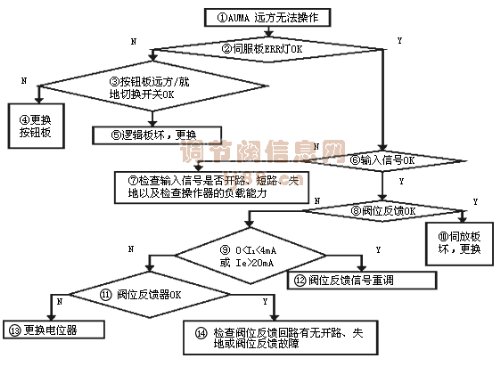
Tree 2 resolves "no remote operation".
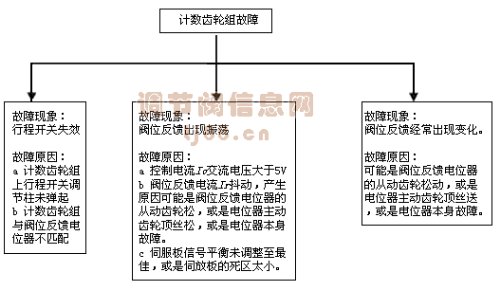
Tree 3 resolves counting-gear-train faults (drifting feedback, oscillation, limit-switch failures).
Since adopting AUMA in 1999, the plant's automatic-control availability rose from 20% to 98%, with better control quality and less maintenance. Careful study of imported equipment allows it to be maintained competently in-house.
1.1.1 Mechanical limit adjustment
(1) Travel: open the side cover of the NORM unit; handwheel the valve fully closed and press adjuster A1 in the WDR direction until counting cam C reaches the closed mark D; same for full open with A2/C2/D2.
(2) Torque: loosen the two screws beside the closing travel column A1 and set the closing torque; similar for opening.
(3) Operate electrically locally to verify travel and torque action.
1.1.2 Position feedback adjustment
Close fully locally and adjust the zero potentiometer W until feedback is exactly 4 mA; open fully and adjust the span potentiometer until 20 mA; repeat zero and span.
1.1.3 Signal balance adjustment
Balance the command and feedback signals per the table:
| 输入信号 | 阀门位置 | 调节方法 |
| 4mA | 全关 | 顺时针调节 P3,使对应的关灯恰好亮 |
| 20mA | 全开 | 逆时针调节 P4,使对应的开灯恰好亮 |
(1) Avoid scrambling the travel: the counting gear train comprises the position potentiometer, driver and driven gears, variable gears, counting gear, travel cams, torque cams, counting cam and travel column. If the potentiometer bottoms out before the gear train reaches the end, the mismatch disables the travel switches and causes gear slippage. If the travel is scrambled, loosen the potentiometer nut, lift the driven gear to disengage, and wind the potentiometer back.
(2) AUMA modulating actuators have a 250 Ω load capability, while ordinary operationers parallel 250 Ω resistors for 1–5 V output — this can cause "works locally, not remotely". Remedy: short the operationer's 250 Ω resistor or insert a signal isolator, which also improves AUMA interference immunity.
(3) Counting-gear ratios differ between travel ranges — do not substitute between actuator sizes.
Tree 1 resolves local open/close failures. Its "step 3" covers mechanical faults (gear wear from lost lubrication, bearing wear from misalignment, slipping manual/auto changeover), and "step 10" motor thermal-trip — mainly caused by actuator-to-stem misalignment. Align by measuring the output shaft to the four supports at closed/mid/open positions and shimming the mounting flange until the axes coincide:
| 位置 | 支架1 mm | 支架2 mm | 支架3 mm | 支架4 mm |
| 全关 | 60.5 | 60.5 | 59.5 | 59.5 |
| 中间 | 60.2 | 60.2 | 59.9 | 59.9 |
| 全开 | 60 | 60 | 60.1 | 60.1 |
Tree 2 resolves "no remote operation".
Tree 3 resolves counting-gear-train faults (drifting feedback, oscillation, limit-switch failures).
Since adopting AUMA in 1999, the plant's automatic-control availability rose from 20% to 98%, with better control quality and less maintenance. Careful study of imported equipment allows it to be maintained competently in-house.