In recent years the dominant specialised valve and actuator makers have each launched fieldbus control systems designed for valves and actuators: Limitorque's DDC-100TM (USA), Keystone's KEYDIG (USA) and Rotork's Pakscan IIE (UK). However their structures, buses and protocols differ, all fully realise communication and intelligence between field devices and the host computer — and the systems are simple, reliable and economical, winning users over.
The valve/actuator fieldbus control system is a newly developed "FCS" (field control system) built to user needs. Its configuration is flexible and highly adaptable, neatly solving the commonest field problems — interference noise, control distance, contact ratings and environment — revealing a vast potential market and prospects in the valve and actuator world.
With good noise rejection, these systems communicate internally over screened twisted pair or cheap unscreened three-core cable. Installation is simple and commissioning fast, costing only about 40% of conventional systems. Conventional wiring reaches six, seven, a dozen or even twenty-two cores per valve or actuator; the fieldbus system connects all of them with just two or three cables (except local power).
Per requirements and scale, one communication loop of 10–20 km accepts 100–250 field devices — valves, actuators and more. Information reaches every device without repeaters, and distances between loop members are unrestricted.
Function-rich, capable and reliable, the systems suit special duties and work safely long-term even in very harsh environments. All the vendors' systems have passed years of field service and user acceptance — true FCS.
Users may specify and configure freely: the system joins process control as master or subsystem; valves and actuators can be set as intelligent or semi-intelligent units. Master-station redundancy, emergency panels, all kinds of I/O interfaces, multi-station systems and multitask software are configurable as needed.
Internal communication uses RS-232 for short distances and RS-485 for long; all signal I/O uses plug connectors — internal wiring is so simple that standard tools and a few instruments suffice, sometimes done skilfully by the field operators themselves.
Different systems are structurally similar: a master station, a communication loop and field units (valves or actuators themselves). See Fig. 1.
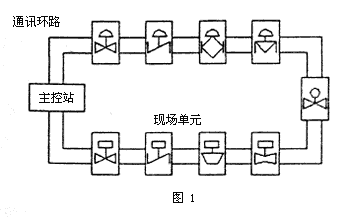
Fig. 1 System structure
Master stations are usually industrial PCs, using keyboard and display to control and monitor operating mode and status. With the rich software packages users easily build colour screens for operating modes, system status and control logic, issue commands via the keyboard and set operating parameters. Fig. 2 shows a PC-based master station of the DDC-100TM and KEYDIG systems.
Panel-mounted master stations also exist, such as Pakscan IIE's: its faceplate carries an LCD monitoring the loop, a keyboard for parameters and data, and lamps showing running and alarm status. From the panel users set loop baud rate, field-unit addresses and transmission parameters. If the master fails or the system misbehaves, operators can drive valves/actuators directly from the keyboard; and for emergencies the panel carries emergency buttons to close the system's most important valves. Fig. 3 shows Pakscan IIE's redundant panel-mounted master: on master failure it switches to the standby within 50 ms, keeping the system safe and reliable.
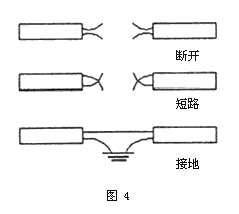
Fig. 2 PC-based master station
As noted, conventional signal wiring between field valves/actuators and the control room is complex, hard to install and maintain, and costly. The two- or three-core cable of the fieldbus system is simple to install and maintain, efficient, cheap and economical. Especially when all valves and actuators are daisy-chained with this cable into a closed loop, every device can exchange information with the master in both loop directions — effectively adding a redundant communication path.
During operation, besides normal work, the loop cable is scanned continuously for integrity. If intact, the master sends control commands per process needs and receives status back. All field units have preset addresses, ready for commands and polling. The master issues commands repeatedly, each requiring an acknowledgement from the addressed unit — otherwise the system treats it as a loop fault. Response time depends on unit count and loop length.
If the loop breaks, field units either side of the break automatically form complete loops of their own sides, maintaining communication between master and all units. Fig. 3 shows common loop faults; Fig. 4 the principles of normal and broken-loop operation.
After a break the master first sends through port A to the first unit and receives its acknowledgement, then the second, and so on, extending the connected loop step by step until the break. Meanwhile through port B it commands and receives in the reverse direction up to the units before the break. This way the master locates the break from both directions and identifies the return paths the units on either side formed, keeping master-to-unit communication uninterrupted.
As a necessary loop check the master repeats the procedure — issuing commands and receiving acknowledgements. Normally commands go out at port A and acknowledgements return at port B.
Field units are Smart controllers specially designed for the valve/actuator requirements, rack-mounted or integral with the actuator. Either way they serve with the valve or actuator as intelligent or semi-intelligent devices.
Semi-intelligent units are simply distributed I/O of the master: they execute the master's commands on the valve or actuator and report status and information back for collection, recording, display and control.
Intelligent units, besides communicating with the master over the loop and working on its commands, can form loops with valve or actuator alone, offering valve positioning, logic control, batch operations, PID control and multi-loop running — richer, more precise control of position, flow, pressure and level.
Intelligent or semi-intelligent, rack or integral, these units carry the special functions valve/actuator operation needs:
For harsh field service, field units use high-reliability components, surface-mount technology, rugged double-sealed housings and special hardware/software anti-interference techniques for long, safe, reliable operation.
What keeps these systems efficient and orderly are the fieldbus protocols they use.
Before full international standardisation, specialist companies developed their own systems for their own interests — alike in some ways, different in others; buses and protocols partly shared, partly distinct. Limitorque's DDC-100TM uses Intel's Bitbus — a serial bus interface, physical layer RS-485, channels based on IBM's SDLC. It is compatible not only with Limitorque devices on the loop but, via dedicated interfaces, with DCS and PLCs from Honeywell, Foxboro, Taylor and others — very handy in practice.
Keystone's KEYDIG uses the Valvbus bus, communicating over RS-232/RS-485 with Modbus or ASCII protocols. Valvbus also employs a patented signal waveform forming a strong digital carrier, giving extreme interference immunity with no restrictions on cable type.
Rotork's Pakscan IIE uses the Modbus protocol, designed for fast reliable communication at a rated 2,400 baud: transmitting one command to a field unit takes 27 ms; scanning a loop of 240 units takes 1.9 s; a 60-unit loop scans in 0.4 s.
Besides, some makers are developing or producing valves, I/P converters and actuators on HART and FF protocols; China's Ninth Five-Year Plan also organised development of HART and FF instruments, actuators included.
Despite their particularities and differing LANs and standards, every one of these protocols serves fully digital, bidirectional, multi-drop communication between field instruments and control systems, implemented in software and hardware: lower-layer functions chiefly in hardware, higher layers chiefly in software.
The fieldbus control system's applied history spans only a few years. Yet it has transformed valve/actuator control and maintenance, solving the wiring, commissioning and repair problems that long plagued process control. It has changed traditional control-system structure — and will exert a great and far-reaching influence on process control.