At a power plant, the large bypass electric actuator (a SIPOS 5 Flash ECOTRON, the economy-type unit of the SIPOS 5 Flash series) on the condensate polishing system of Unit 3 kept doing something strange in the spring of 2010: the valve opened by itself, although no one had issued an open command. It happened repeatedly over two weeks, at seemingly random moments, and the instrumentation & control (I&C) crew never managed to witness an event in person despite standing watch. With the plant in the middle of a critical power-supply guarantee period, this phantom fault became a top-priority investigation.
The maintenance team went through the field conditions and found five odd points:
1. Operators had never issued an open command, and there was no open-command record in the DCS;
2. A check of the PLC sequence logic confirmed that no interlock condition existed that would open the large bypass;
3. Repeated remote and local operation of the actuator worked perfectly in both directions;
4. The unwanted openings occurred at random, and the energization of the relay (24 V DC) lasted only about one second — nearly impossible to catch even when someone was standing right there;
5. After each unwanted opening, a close command from the DCS closed the valve normally, and everything behaved as usual.
In other words, the actuator looked "healthy" — yet it moved on its own, with no one commanding it.
The crew first ruled through the most obvious directions:
- Spurious relay pickup? Unlikely — the open-command relay was a 24 V DC type with strong interference immunity, wired to a normally-open contact that only picks up when energized;
- Broken conductor or short circuit in the circuit? Unlikely — remote operation was normal, which showed the loop was intact;
- Electromagnetic interference causing the actuator to misoperate? This was what the crew considered most probable, yet even the manufacturer did not think it likely.
With all three paths half-open and half-blocked, the team shared the symptoms and their analysis with peers in the field, and the troubleshooting directions that came back were highly representative.
Direction 1: damaged control cables and damp intermediate joints causing shorts. This turned out to be the most frequent cause among similar cases. Several plants reported almost identical experiences: at one plant, multiple Yangxiu actuators repeatedly opened and closed by themselves with no DCS command; a site check revealed damaged outer sheaths on the actuator control cables, which shorted whenever they got damp — after the cables were repaired, the fault never returned. At another plant a Rotork actuator "opened by itself every time it rained," again traced to a damaged control cable. A third plant's pulverizer-exhaust hot-air damper misoperated because of a poorly routed cable joint that shorted. The advice was concrete: megger the control cable insulation, ask the electrical crew to run a withstand-voltage test to locate sheath damage, and pay special attention to intermediate cable joints — where shields and insulation are often poorly finished, allowing interference voltages into the loop. One I&C engineer reported measuring a 100 V interference voltage on a cable whose shield was intact. If the fault could not be located, laying a temporary new cable in parallel and observing for a period cleanly separates internal from external causes.
Direction 2: the actuator's own boards. Some peers suggested simply swapping in another actuator and letting the problem "reveal itself": if the fault disappeared after replacement, the original actuator was to blame; if it persisted, the cause was external. Board-level examples abounded: at one plant a SIPOS unit hunted when placed in automatic; no cause could be found until the boards were replaced one by one — after the control board and power supply board were changed, the symptom vanished. Elsewhere a control valve closed fully by itself because a relay contact had welded, feeding power to close the motor; replacing the relay cured it. Multiple reports pointed at power supply boards — "after a capacitor burns out, the board starts behaving insanely" — especially in hot locations, where power boards fail readily while control boards almost never do.
Direction 3: interference and grounding. Check whether the analog input lines are shielded cable and whether the shield is solidly single-point grounded; where possible, measure whether an AC component is superimposed on the PLC output channel — if so, interference becomes the prime suspect.
Interim measures: before the cause was found, the plant handled it pragmatically during the guarantee period — operate locally when needed, then switch off power afterward to prevent another unwanted stroke.
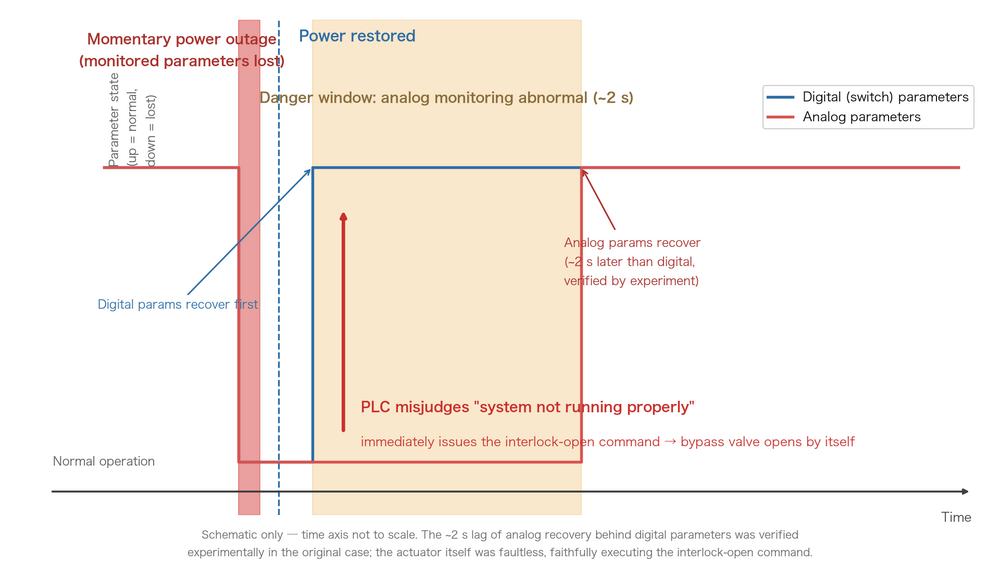
Fig.1 After the momentary outage, analog parameters lag behind digital ones; the PLC misjudges within the window and issues the interlock-open command (diagram by this site)
Nobody had guessed it: the real cause lay neither in the actuator nor in the cables, but in the combination of power-supply quality and sequence logic.
The PLC cabinet's main power supply dropped out momentarily. During the instant outage all monitored parameters disappeared; after the supply recovered, the parameters came back one by one — but the analog quantities recovered nearly 2 seconds slower than the digital ones (verified by experiment at the plant). So after every momentary outage, the PLC sequence judged that "analog monitoring was abnormal — the system was not running properly," and immediately opened the large bypass by interlock, exactly as programmed.
With the answer on the table, everything fit: no operator had issued the command — the sequence logic itself had; the finding that "no interlock condition could occur" had also been correct — under normal conditions it truly could not, and the abnormal trigger was that brief power dip. Remote operation, naturally, was flawless. The actuator had been innocent all along: it had merely executed a command whose origin no one understood at the time.
The plant's fix: feed a second power source into the main supply, providing dual-power supply. The system has run normally ever since, with no recurrence. Peers in the discussion reached a consensus as well: PLC sequence cabinets should be equipped with a UPS or dual supplies — and note that a UPS itself can drop out, so redundant supplies are the dependable practice.
When an electric actuator "moves by itself with no command," work through the following order:
1. Separate the three suspects first: where the command came from (DCS/PLC event records), the actuator itself, and the external circuit (cables/relays) — isolate them one by one;
2. Control cables are the most frequent culprit: sheath damage, intermediate joints, and damp-induced shorts dominate such cases — megger the insulation, inspect joints, and substitute a new cable if necessary;
3. Use component swapping to isolate board faults: power supply boards (capacitors in particular), control boards, and welded relay contacts — replace board by board, or swap the whole actuator, and internal vs. external causes become obvious;
4. Do not overlook power quality and sequence logic: momentary supply outages, the recovery-time difference between analog and digital parameters, and interlock conditions can all make an innocent actuator take the blame;
5. During critical guarantee periods, take interim measures first: operate locally and de-energize afterward until the cause is found.