A cement plant's wet-process line operates dozens of electric actuators, most controlling process control valves through hand-operators and servo amplifiers. Harsh conditions and aging electronics made the servo amplifiers failure-prone: amplifier oscillation caused actuator hunting and motor brake failures, raising fault rates and disturbing process parameters. This article presents a retrofit that replaces the servo amplifier with DCS "servo-less" control.
1. Original control principle
The hand-operator feeds a 4–20 mA signal to the pre-stage magnetic amplifier (a DC-output internal-feedback push-pull circuit). The given signal is compared with the actuator position-transmitter feedback; an electronic switch and trigger circuit drive the servo motor forward or reverse until given and feedback balance, with the feedback process displayed on the hand-operator.
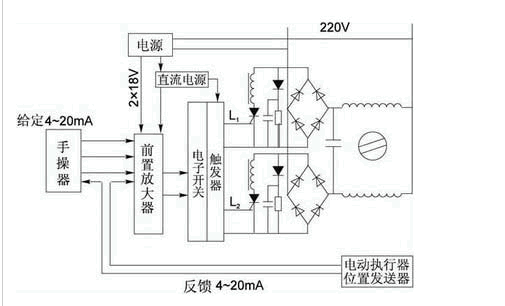
Fig.1 Servo amplifier control principle
The "zero" and "stability" potentiometers in the magnetic amplifier are the key to whether the actuator oscillates — and a frequent failure point; the thyristors, diodes, current-limiting inductors and unijunction transistors in the switch/trigger circuit are equally fragile.
2. Servo-less control
During the No.3 kiln retrofit a plant-wide DCS was installed. Based on long actuator experience, five actuators (bag-filter fan inlet dampers, cold-air valves) on the No.3 coal mill were converted to servo-less control with RC arc suppression and RV varistors: ladder logic in the DCS emulates the servo amplifier's compare/amplify functions for both 220 V and 380 V actuators, digital-output modules drive the motors, and analog-input modules acquire valve position feedback.
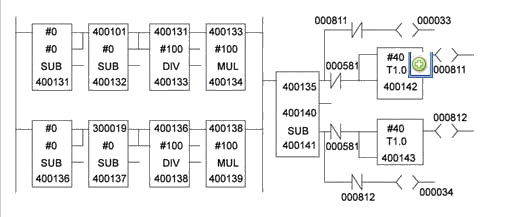
Fig.2 Servo-less control ladder program
In the ladder program, the operator's setpoint (e.g. register 400101) is scaled and rounded into the compare register (400135); the feedback (300019) likewise into 400140; the comparison drives coils 000033/000034, energizing interposing relays K1/K2 and contactors KM1/KM2 for forward/reverse rotation — servo-less operation achieved.
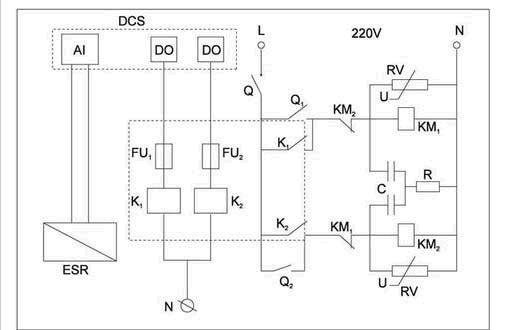
Fig.3 Actuator control principle (DCS: control system; ESR: position transmitter; Q: breaker; Q1/Q2: maintenance switches; RC: arc suppressor; RV: varistor)
"#100" in the program is the rounding value — the valve-position control precision, i.e. the dead band; use "#50" or smaller where higher accuracy is required (equivalent to the "stability" potentiometer). 000581 is a reset coil; "#40" auto-drops the output after 40 s. The retrofitted hardwired circuit suits both 220 V and 380 V actuators. Centralized control adds two interposing relays and one local control box per actuator; better still, agree with the manufacturer to build the contactors, RC suppressor and varistor into the actuator. Our plant applied this to Siemens actuators on the line.
3. Results
After more than half a year in service, the five servo-less actuators show greatly improved automatic control, full tolerance of the harsh cement-plant environment, reliable unmanned operation, low failure rate, and sharply reduced maintenance — plus the cost of hand-operators and servo amplifiers was saved. RC suppression and varistors keep the drive circuit arc-free for long-term safe operation and provide stable, accurate process parameters.
We supply electric actuators of all major brands with spare parts and control-system retrofit support — contact us.